
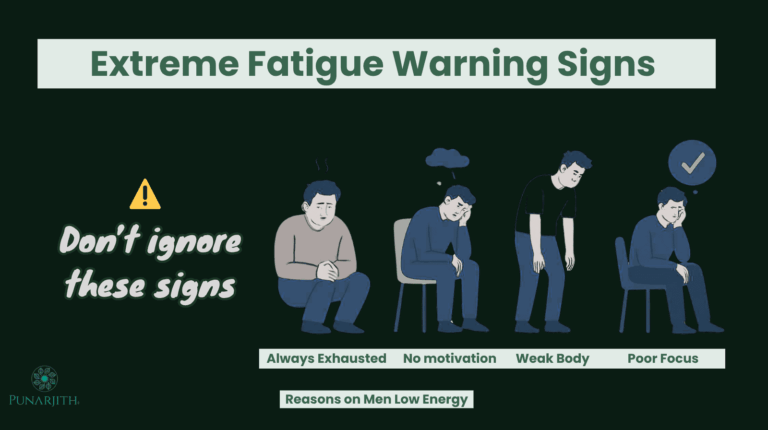
A low-energy male may experience:
- Constant tiredness
- Lack of motivation
- Reduced focus
- Weak physical performance
- Mood changes
These symptoms affect both personal and professional life.
1. The Heavy Weight: Constant Tiredness
This is the most visible symptom, but it goes deeper than just feeling sleepy.
The “Unrefreshing” Sleep: You may sleep for 8 hours but wake up feeling as though you haven’t rested at all. This suggests that the quality of your metabolic recovery is compromised.
Physical Heaviness: Even simple movements, like walking up a flight of stairs or carrying groceries, feel like they require a disproportionate amount of effort.
2. The Ambition Gap: Lack of Motivation
In men, energy and motivation are closely linked to neurochemistry.
Dopamine Depletion: Low energy often mirrors low dopamine levels. When your “reward” system isn’t firing, tasks that used to be exciting now feel like chores.
Procrastination: It’s not laziness; it’s a lack of “start-up energy.” The mental hurdle to begin a project becomes so high that you find yourself avoiding responsibilities you once handled with ease.
3. The Foggy Lens: Reduced Focus
Mental clarity requires a significant amount of cellular energy. When that energy is diverted elsewhere, cognitive function is the first thing to suffer.
Short-Term Memory Lapses: Forgetting names, losing your keys, or losing your train of thought mid-sentence.
The “Brain Fog”: A feeling of being mentally “cloudy,” where processing complex information takes twice as long as usual.
4. The Performance Ceiling: Weak Physical Stamina
For many men, their identity is tied to their physical capability. Low energy hits this hard.
Gym Plateau: You might find that you can no longer hit your usual weights, or that your recovery time after a workout has doubled.
Loss of “Drive”: This isn’t just about the gym; it can also manifest as a decreased interest in physical intimacy or a general lack of vigor in your daily posture and movement.
5. The Emotional Shift: Mood Changes
When the body is struggling to maintain its baseline, the nervous system becomes “brittle.”
Irritability: Small annoyances that you would normally brush off now trigger a disproportionate anger or frustration response.
Social Withdrawal: Because social interaction requires energy, a low-energy male may start declining invitations, preferring to isolate himself to “save” what little energy he has left.
Low Energy Levels in Males
1. Hormonal Changes
As men age, or due to high-stress environments, the delicate balance of hormones can shift.
Testosterone Decline: Often gradual, a drop in testosterone reduces the body’s ability to maintain muscle mass and metabolic rate, leading to persistent lethargy.
Cortisol Dominance: Constant stress keeps cortisol levels high, which eventually “burns out” the system, making it difficult for the body to transition into a state of rest and repair.
2. Poor Sleep Cycle
It is a common misconception that “quantity” of sleep is the only metric that matters. Consistency is equally vital.
The Rhythm Break: Going to bed and waking up at wildly different times disrupts the circadian clock, which regulates energy-producing hormones.
Sub-Par Deep Sleep: Even if you spend eight hours in bed, factors like alcohol, caffeine, or late-night blue light exposure can prevent the brain from reaching the restorative stages of sleep necessary for mental clarity.
3. Nutritional Deficiencies
Energy is a chemical process. If the body lacks specific “catalysts,” it cannot effectively convert food into fuel.
Critical Minerals: Deficiencies in Magnesium and Zinc are common in men and are directly linked to both testosterone production and cellular energy (ATP) creation.
The “Hidden” Hunger: You can be caloric-surplus (eating a lot) but nutrient-deficient. A lack of B vitamins or Vitamin D often manifests as a “heavy” feeling in the limbs and a lack of mental drive.
4. Stress and Mental Overload
The brain consumes about 20% of the body’s total energy. When you are under constant mental pressure, the “processing power” required leaves very little energy for the rest of the body.
Decision Fatigue: A day spent making high-stakes decisions leaves the prefrontal cortex exhausted, often leading to a physical “crash” in the evening.
Sympathetic Overdrive: Being “always on” keeps the nervous system in a state of agitation, draining energy reserves that should be used for physical recovery.
5. Lack of Downtime
Many men confuse “distraction” with “recovery.”
Active vs. Passive Recovery: Scrolling through social media or watching intense television is passive distraction, but it doesn’t actually allow the nervous system to reset.
The Maintenance Phase: Without intentional periods of stillness—such as light walking, meditation, or deep breathing—the body never exits its “operating mode” to perform essential internal maintenance.
Conclusion on Low Energy on Men
Low energy in men is not a single problem—it is the result of multiple factors working together. From lifestyle habits to hormonal balance, everything plays a role.
By identifying the root cause early and making small changes, it is possible to regain energy, strength, and overall well-being.